

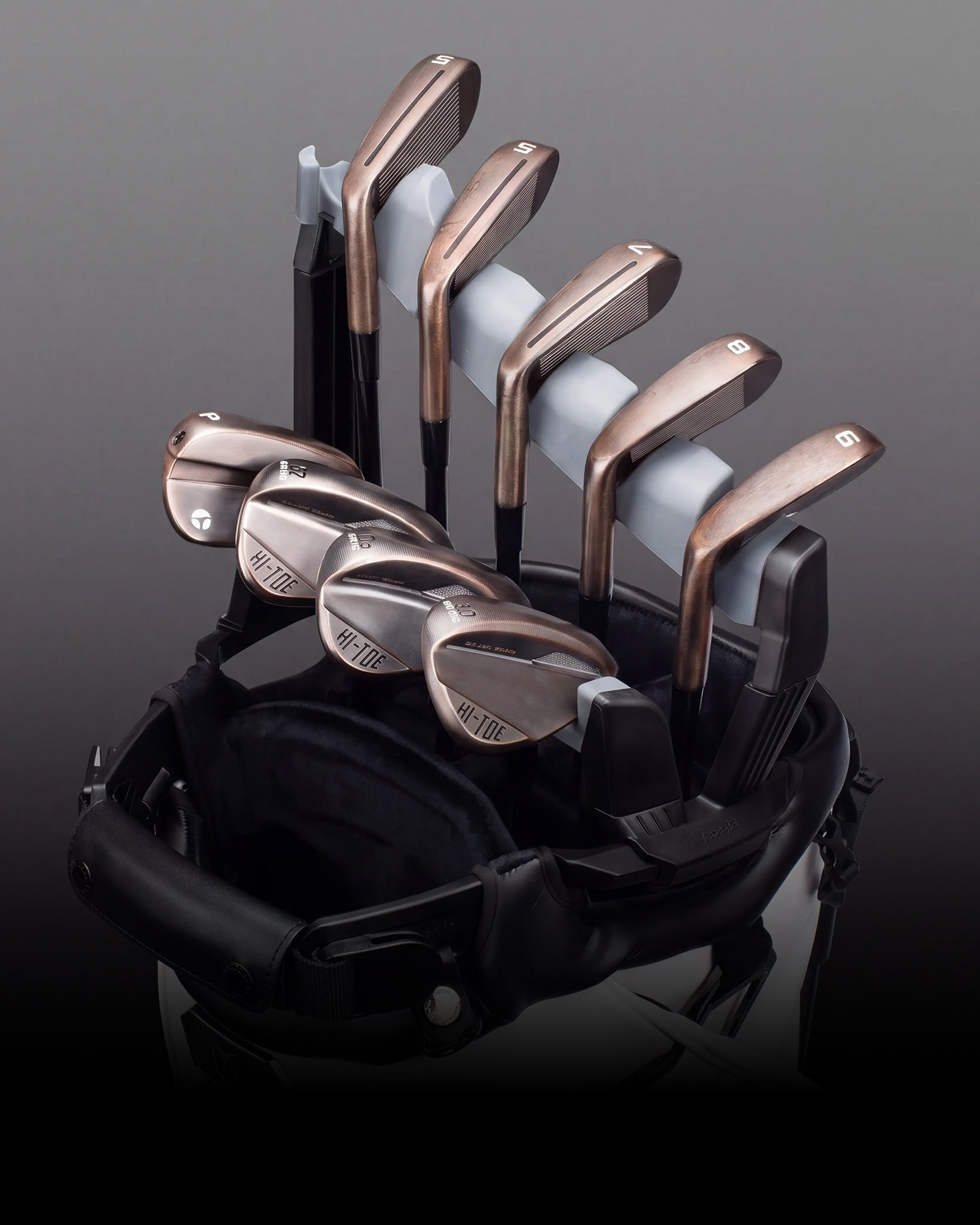





The numbers on your golf clubs tell you the loft angle, which is how tilted the clubface is and this directly controls how high and far your ball flies. Lower numbers mean less loft and longer distances, so a 5-iron travels farther than an 8-iron. Each club typically has a 10-15 yard gap between it and the next, with most irons numbered 3 through 9. Wedges break this pattern by using actual degree numbers instead, like 52° or 56°, giving you precise control for short shots around the green, and there's plenty more to understand about choosing the right clubs for your game.
Table of Contents
What Golf Club Numbers Actually Mean: The Loft and Distance Connection
When you're standing in the fairway trying to figure out which club to grab, those numbers stamped on your irons aren't random; they're actually telling you a specific loft and distance.
Each number directly corresponds to the club's loft angle. Your 8-iron has a loft of 37-39 degrees, while your 9-iron has a loft of 41-43 degrees. That small difference creates a 10-15 yard gap between clubs, which is exactly what you need for precise shot-making.
Lower numbers indicate less loft, which means longer distances. Think of it this way, your driver (the 1-wood) has only 7-12 degrees of loft for maximum distance, while your pitching wedge carries 46-50 degrees for those high, controlled shots. The progression is systematic throughout your entire bag! Higher loft angles produce higher ball trajectories, giving you better control on approach shots to the green.
How Numbers Work on Irons, Woods, and Drivers
Understanding how numbers work across your different clubs gets a bit trickier than you might expect, because not every club type follows the exact same numbering system. The important point is: your driver rarely shows a number anymore, though it'll display its loft (9° to 12°) right on the sole. Fairway woods use actual numbers 3-wood sits around 15°, while a 5-wood measures 18-19°. Irons run from 1-9, but modern sets typically start at 4-iron since long irons are tough to hit. After your 9-iron, there's no 10-iron; instead, you'll shift to your pitching wedge, which fundamentally acts like a #10. Hybrids bridge the gap, replacing those difficult long irons with numbers that match their distance. Lower-numbered irons hit the ball farther with less loft, while higher-numbered irons provide more height and shorter distances for precise approach shots. Woods feature larger heads and longer shafts specifically engineered for maximum distance off the tee or from the fairway.
Why Lower Golf Club Numbers Always Hit Farther
Now that you know which numbers belong to which clubs, let's talk about the big question: why does your 7-iron consistently send the ball sailing 30-40 yards past your 9-iron?
It's almost entirely about loft angle. The clubface angle accounts for roughly 85% of the difference in distance between clubs, with club length accounting for the remaining 15%. Each degree of loft you reduce adds approximately 3-5 yards to your shot. Your 7-iron typically has about 34 degrees of loft, while your 9-iron sits around 42 degrees. That 8-degree difference translates to significant yardage.
Lower loft creates a flatter, more penetrating ball flight that enhances distance, while higher loft produces those satisfying high shots that land softer. However, the loft stamped on your club is just the static loft at rest, and the actual loft delivered at impact, called dynamic loft can vary based on your swing path and angle of attack. Manufacturing tolerances mean that no clubhead meets perfect specifications, with standard tolerances of +/-1 degree potentially affecting your distance gaps between clubs.

How Wedge Numbers Break the Standard Pattern
Once you reach the wedges in your bag, the familiar iron numbering system vanishes completely. Instead of seeing "10-iron" or "11-iron," you'll find names like pitching wedge, gap wedge, and lob wedge. The point is that wedges are identified by loft degrees. Your pitching wedge might range from 44° to 48°, while a gap wedge sits at 50°-52°. Sand wedges typically measure 54°-58°, and lob wedges go even higher at 58°-64°.
The spacing changes, too. You'll want 4°-6° gaps between wedges instead of the standard 4° separation in irons. Most golfers carry 3-4 wedges rather than a full sequential set, customizing their short-game arsenal. The gap wedge was created to fill the loft space between the pitching wedge and sand wedge as modern iron lofts became stronger. This flexibility lets you prioritize precision around the greens over distance consistency!
Understanding wedge lofts becomes critical when you realize that two-thirds of golf shots occur from 125 yards or less.
Which Golf Club Numbers You Should Actually Carry
Knowing wedge lofts matters, but what really trips up golfers is figuring out which clubs deserve a spot in your bag when you're limited to just 14. The point is your handicap determines your ideal setup. If you're a 0-15 handicapper, you'll likely use all 14 clubs effectively. But higher handicappers? You don't need that specialized lob wedge yet. Mid-handicap players should prioritize distance gaps over finesse shots. That means carrying hybrids instead of tough-to-hit long irons. Consider this: only 6% of 20-handicappers can hit a 200-yard hybrid consistently, compared to 32% of scratch golfers. Focus on clubs that straighten out your game initially. You can add specialty clubs as your skills improve and you actually need them! For recreational golfers who struggle with penalty strokes, reducing mistakes off the tee should take priority over adding finesse wedges. Professional club fitting helps measure carry distances and can identify problematic gaps in your set that lead to poor club selection on the course.
Frequently Asked Questions
Do Women's Golf Clubs Have Different Numbers Than Men's Clubs?
No, women's golf clubs use the exact same numbering system as men's clubs. A 7-iron is a 7-iron regardless of who's swinging it! The difference isn't in the numbers, it's in the club's physical design. Women's clubs typically feature lighter shafts, more flexible materials, and slightly shorter lengths to match average swing speeds and heights. The loft angles and numbering conventions stay identical though.
How Often Should I Replace My Golf Clubs as Technology Changes?
You'll want to replace your clubs every 3-7 years, depending on the type and how often you play. Drivers need to be replaced every 3-5 years because technology advances rapidly, while irons last 5-6 years for most players. If you're playing frequently, consider upgrading every 2-3 years to keep up with tech improvements. Watch for groove wear, distance loss, and shaft damage these signal it's time for new clubs!
Are Hybrid Club Numbers the Same as the Irons They Replace?
Yes, hybrid club numbers match the irons they replace. A 4-hybrid has the same loft as a 4-iron (around 23-28°), so you'll get similar distance and ball flight. The point is manufacturers design it this way on purpose to make swapping clubs super easy. You're looking at the same 170-190 yard range, whether you pick the 4-iron or 4-hybrid, just with easier launch from the hybrid!
Do Professional Golfers Use Different-Numbered Clubs Than Amateurs?
No, professionals and amateurs use the same numbered clubs; the numbers stay standardized across all skill levels. The reality is: the difference isn't in what clubs they carry, but how they choose which one to use. You might grab a 7-iron based solely on distance to the pin, while a pro considers wind, hazards, and green slope before selecting that same 7-iron. It's a strategy, not equipment!
Conclusion
Understanding golf club numbers isn't rocket science, it's all about loft and distance. Lower numbers mean less loft and more distance, while higher numbers give you more loft for shorter, higher shots. Once you've got this down, you'll know exactly which club to grab for any situation on the course. Now get out there and put those numbers to work! Your scorecard will thank you.


